Proton Motive Force: The Currency of Mitochondrial Energy
Dec 15, 2025
Proton Motive Force: The Currency of Mitochondrial Energy
By Victor Sagalovsky
At the heart of vitality, there is no single molecule, no singular gene or breath or beat. There is only the force that moves between them all—the subtle river of life’s electricity, ancient, invisible, and essential.” Long before man knew what mitochondria were—before the double helix whispered its elegant song, before the word “proton” danced on the tongue of a physicist—there was the force. Not a metaphor, not a mystic chant, but a measurable, push-and-pull energetic reality that drives the beating of your heart and the clarity of your thoughts. A force that animates flesh, fuels motion, and in the deepest sense of the word, enlivens us.
This force has a name: Proton Motive Force, or ΔµH⁺.
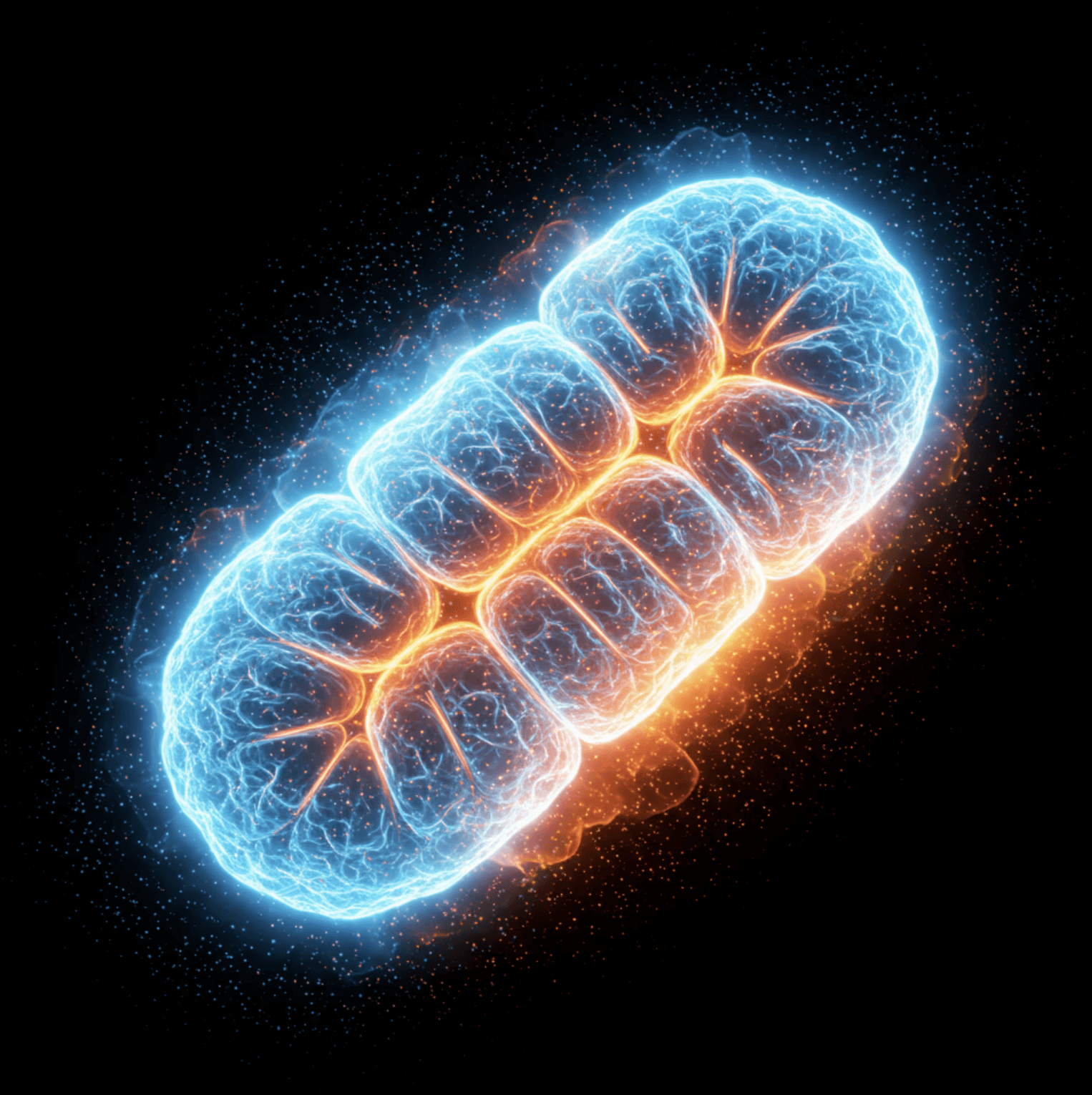
To understand this force is to journey to the deepest sanctum of biology—the inner mitochondrial membrane. In the twilight between the matrix and the intermembrane space, electrons cascade through Complexes I, III, and IV of the electron transport chain, pumping protons outward with each redox transaction.
This is not a leak but a dam—a carefully engineered gradient. A build-up of protons forms two gradients:
A chemical gradient: high [H⁺] outside, low [H⁺] inside
An electrical gradient: positive outside, negative inside
Together, these gradients produce the electrochemical potential—ΔµH⁺—a ~180-220 millivolt charge difference across a membrane only five nanometers thick. Protons race back into the matrix through ATP synthase, a rotary nanomotor of astonishing sophistication. As it turns, it forces ADP and phosphate together, forming ATP.
This system—electrons, pumps, gradients, motors—runs in your body at astronomical scale: You produce and use your entire body weight in ATP every day.
But this force is fragile. ΔµH⁺ is vulnerable to:
Mitochondrial damage
Environmental toxins
Chronic inflammation
Metabolic dysregulation
Isotopic contamination
And the most insidious threat? A heavier version of hydrogen itself: Deuterium.
Deuterium is a naturally occurring isotope of hydrogen—identical in charge, but double the mass. That subtle difference creates chaos in a world of precision.
When deuterium replaces normal hydrogen in the structure of water, fatty acids, or nucleotides, the consequences ripple through metabolism:
Deuterium oxide (HDO, D₂O) alters hydrogen bonding and membrane viscosity
Deuterated fatty acids slow membrane turnover
Enzyme kinetics suffer from kinetic isotope effects—reactions slow down, stutter, or fail entirely
ATP synthase—sensitive to the mass of the ions it channels—is physically impeded by deuterium’s bulk
In short: deuterium lowers the efficiency of the proton gradient. It clogs the engine. It steals voltage from the inner membrane. It dims the inner flame.
Most modern water supplies contain 145-155 ppm of deuterium. In a pristine, pre-industrial environment, it may have been closer to 130 ppm. That subtle elevation—from 130 to 150 ppm—represents a nearly 50% increase in isotopic burden across trillions of water molecules.
And mitochondria—being 80% water by volume—feel it most acutely.
To reverse mitochondrial decay and reestablish a robust proton motive force, we must lower the body’s deuterium burden. The science is young, but the principles are clear and the effects profound.
1. Drink Deuterium-Depleted Water (DDW)
Commercially available DDW (25–105 ppm) reduces systemic deuterium over weeks to months. Even a shift from 150 ppm to 120 ppm can:
Improve Complex I function
Increase Δψ (membrane potential)
Enhance ATP output per oxygen consumed
2. Metabolic Deuterium Cycling
Burning fat produces endogenous “metabolic water” that is naturally low in deuterium
Ketogenic diets minimize glucose oxidation, which produces deuterium-rich water
Intermittent fasting and fasted exercise encourage beta-oxidation and mitochondrial autophagy
3. Avoid High-Deuterium Foods
Limit: starches, tropical fruits, root vegetables, sugars
Prefer: leafy greens, pasture-raised meats, high-fat low-carb meals, and structured water sources.
Oxygen is the final electron acceptor in the mitochondrial chain. But oxygen, improperly managed, becomes dangerous—producing reactive oxygen species (ROS) that damage membranes, DNA, and the very electron transport chain it was meant to support.
To optimize the performance of mitochondria, we must both deliver oxygen efficiently and reduce it cleanly.
1. Hyperoxygenation Protocols
Hyperbaric oxygen therapy (HBOT) enhances tissue oxygenation, supports stem cell activity, and triggers mitochondrial biogenesis
Ozone therapy (in controlled therapeutic doses) increases oxidative preconditioning—upregulating endogenous antioxidant systems like SOD and catalase
2. Redox Support
Molecular hydrogen (H₂ gas or tablets): selectively neutralizes harmful ROS, supports NAD⁺ / NADH ratio
Coenzyme Q10 (ubiquinone): facilitates electron transfer across Complex III
NAD⁺ precursors (NR, NMN): enhance electron input into Complex I
3. Oxygen Efficiency Training
Nasal breathing increases nitric oxide production, which enhances vasodilation
Breathwork and CO₂ tolerance training: improves cellular oxygen unloading via the Bohr effect
Altitude simulation: induces EPO, increases red blood cell mass, and mitochondrial density
When deuterium is low and oxygen is optimized, the proton motive force surges. This leads to:
Higher ATP per oxygen molecule
Lower lactate output at threshold
Enhanced fat oxidation
Faster recovery
Sharper focus
Lower systemic inflammation
Slower aging at the mitochondrial level
From elite athletics to neurodegenerative prevention, this model applies across domains.
Mitochondria don’t care if you’re running a marathon, solving a theorem, or simply staying alive another day. Their only concern is gradient. And ΔµH⁺ is the truth they live by.
We have spent centuries pursuing health as if it were a thing to be consumed —vitamins, powders, pills. But health, in its truest form, is electrical architecture. It is the shape and strength of flow.
Proton motive force is the geometry of the energy life of. It is not a metaphor. It is measurable. Trainable. And when respected, it awakens capacities in the human body that border on the mythic. In the final reckoning, we are not what we eat. We are what we flow. Let your protons burn clean. Let your oxygen reduce efficiently. Now seize the day.